
By Ann Bush
The basketball-sized clusters of gray leaves gently waving in the breeze filled the forest canopy. Asked to wait quietly, we all wondered. Expecting to see thousands of orange and black butterflies when we finally arrived at the staging area covering the sides of a small mountain, we wondered where they could be. It had been an early morning, exhausting hike up to 12,000 feet for almost two hours, heightened by the desire to reach the mountain top before the rising sun did. Next time, I’ll take the horse offered at the base.
And then it happened. As the sun brightened the grayness of the undergrowth and shone on the treetop clusters, one of the “leaves” popped open to reveal two flapping butterfly wings. Our guide whispers it is too cold at night to move, so they cluster tightly together to sleep. Just as the morning’s ray of sunshine warmed its little body, it slowly began to move. The crowd ahhhhhed, trying to do so quietly. In synchronized motion, cameras raised, binoculars focused, and people stood up to get solid footing as more butterflies opened their wings.
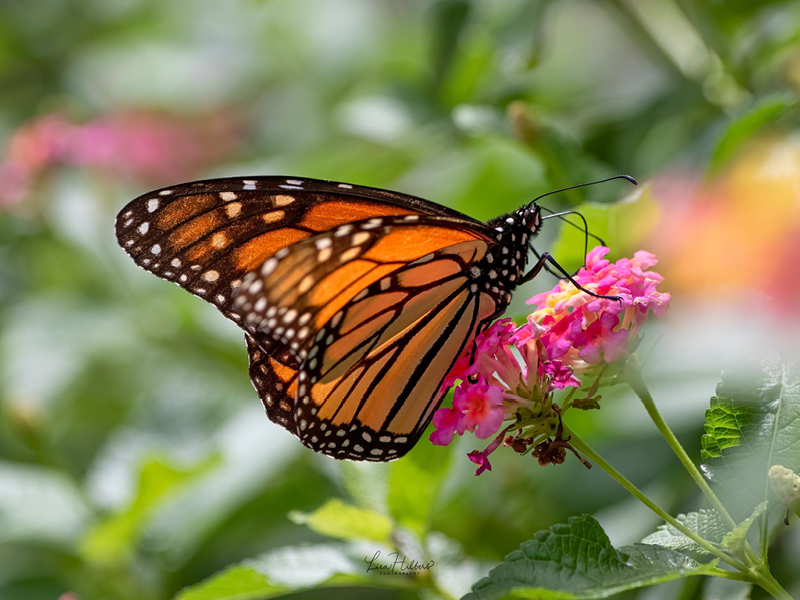
Suddenly, a “gray basketball” burst into many butterflies, all heading towards us through the emerald fir tree boughs, hungry and thirsty. Within 15 minutes, millions of Monarchs with rapidly flapping wings flew past us to feed on blooming wildflowers and drink from mountain springs at the base of the mountain. It was truly a magical moment.
I waited for many years to fulfill this bucket-list vacation, finally arriving at the El Rosario Reserve in Mexico with a group tour in February 2025. This scene is only visible during the January and February months and is one of the few places where monarchs spend the winter. In addition, the trees on these mountains are the only species they use, and no one really knows why.
As I stood in the middle of the Monarch Freeway, butterflies wandered so close to my face that I was mesmerized. My camera hangs on my neck, neglecting to take photos; I’m afraid of missing a second of an authentic moment with my own eyes of this amazing experience. I wonder through the whole process how many of them were related to the monarchs that spent the summer in East Texas before making their way to Canada last year. Will this one on my shoulder soon follow the migrating path that goes right through my East Texas neighborhood?
Millions of monarch butterflies undertake a 3,000-mile migration each fall to escape cold northern winters, traveling from Canada and the northern U.S. through Texas to Mexico. Each migration is a new generation, so they cannot learn from others. Scientists believe they use the sun’s position and Earth’s magnetic field to navigate directionally, but the rest is still a mystery.
The monarchs that migrate south are called the “super generation,” living up to nine months as they travel to Mexico in the fall to stick out the winter. These butterflies enter reproductive diapause, postponing mating to conserve energy. Triggered by shorter days and cooler temperatures, they pause sexual maturity, allowing them to fly the great distance, survive the winter, and begin a northward journey in spring.
Their northward flight has them stopping in Texas to lay eggs. They land on milkweed, eat themselves silly, breed, lay eggs, then die.
When the eggs hatch, baby caterpillars live by eating the milkweed they were born on and morph into butterflies.
This second generation traveling north in spring only lives two to six weeks because they actively mate and lay eggs, starting the cycle of successive generations to complete the northward migration.
The super generation comes through East Texas around late September, peaking between mid-October and early November as they head to Mexico. Their return to East Texas for laying eggs and creating the next generation happens beginning in March through April.
With nature’s blessing at its best, comes a responsibility.
Once abundant, monarch butterfly populations have steadily declined since the mid-1990s because of several threats. They desperately need our help. According to the U.S. Fish and Wildlife Service “over the past two decades, monarch numbers in North America have declined, prompting the U.S. Fish and Wildlife Service to join tribes, state agencies, other federal agencies and non-government groups to identify threats to the monarch and take steps to conserve monarchs throughout their range.”
Everyone — from government agencies to individuals — is needed to ensure a future filled with monarchs. We can all do our part for monarchs in our backyards, in the back 40, and along every back road in Texas along the migrating pathway.
You can help by planting habitat that supports their survival, such as pollinating gardens and milkweed along roadsides, or protecting native prairie habitat. Every little bit of new or preserved habitat benefits all animal species that rely on pollinator plants, and everyone such as bees, birds, or bugs benefits. Every flower is important.
HOW TO HELP
Plant More Milkweed and Wildflowers
The best available science demonstrates that we need every type of land to grow milkweed to reverse the decline of monarchs. This includes private lands, public lands, and rights-of-way. Whether you have a few feet on your apartment balcony, a yard in need of landscaping, or several acres, you can make a difference. Various varieties of milkweed exist; however the best milkweed species for the Southwest Region, which includes Texas, are Antelope horn milkweed (Asclepias asperula), Engelmann’s milkweed (Asclepias engelmanniana), Showy milkweed (Asclepias speciosa)
Support Native Texas Plants
For generations, butterflies found plants along their path that were native, which have unfortunately been replaced with fancy, foreign plants imported for beauty. Every household can be a major contributor to this problem by adding heritage Texas native plants that are pollinators, that also attract birds and bees which have co-evolved with these plants and also depend upon them for survival. In addition, native plants cohesive to the local soil components will enrich local water quality, improve soil health and en-hance ecosystem resiliency.
Be Aware of Misleading Information
Not all milkweed is best for Texas, but it is sold in many mega stores. Tropical milkweed (Asclepias curassavica) can harm monarchs because this plant has an extended blooming period, resulting in more diseases spreading that make monarchs sick. If you have tropical milkweed, remove it and replace it with native milkweed varieties.
When possible, use seeds and plants sourced from your local area. For inspiration, check out the NPSOT (Native Plant Society of Texas) guide for which flowers are best to plant in your pollinator garden.
Ask The Local Experts
Another excellent resource for accurate information as to how, when, and where to plant milkweed or pollinating plants crucial for the survival of the monarchs is with the “Bring Back the Monarchs to Texas” (BBMT) program. A joint effort with Monarch Watch, they create programs and events that educate members and the public about Monarch biology and conservation, encourage propagation and distribution of native milkweeds that support Monarch reproduction, and restore Monarch habitats throughout Texas.
Their annual BBMT grant program makes grants available to schools, nature centers, and other organizations to create additional monarch habitat using native Texas plants. The BBMT committee also helps arrange in-person and remote education opportunities for all Texans on all aspects of monarch biology and conservation, monarch habitats, and gardening for monarchs. To date, hundreds of monarch garden habitats have been installed, and tens of thousands of people have attended educational programs.
For those who can’t plant a butterfly friendly garden but want to enjoy the monarchs, try Tyler’s Rose Garden, East Texas Arboretum, Longview Arboretum, Mineola Nature Preserve, Wood County Arboretum & Botanical Garden in Quitman, Rockwall’s butterfly gardens, and the Gayla Mize Garden and other certified pollinator gardens in Nacogdoches. Heard Museum in McKinney operates a Native Texas Butterfly House & Gar-den.
Jasper is officially designated as “The Butterfly Capital of Texas” and hosts a Butterfly Festival in the fall. The town is home to the Butterfly Gardens at the Jasper Arboretum.
Check with other towns to find out if they have good pollinator programs, perhaps through garden clubs.
Sources
www.fs.usda.gov/wildflowers/pollinators/Monarch_Butterfly/migration/index.shtmlwww.fws.gov/initiative/pollinators/save-monarch
www.npsot.org/our-work/bring-back-the-monarchs-to-texas/

