
Rockwall and Kaufman Counties Offer the Best of Town and Country
By P.A. Geddie
What do the fastest-growing (Kaufman) and the smallest (Rockwall) counties in Texas have in common? They originally were one and the same.
Long before the American settlers arrived, the Cherokees and Caddo Indians lived on land bordered between the Trinity and Sabine rivers in the Blackland Prairie region of Northeast Texas. When the boundaries of Kaufman County were established there in 1848, they included what is now Rockwall County. It was named for David Spangler Kaufman, a U.S. Representative from Texas, who, by most accounts, came from German-Jewish and Mennonite descent. His ancestor who immigrated to the United States came from Germany in 1742.
The county seat was also called Kaufman, located roughly in the center of the county. For 26 years people living in the far northwestern corner of the county, particularly in a community called Rockwall, complained that they had to travel too far to do business, legal, and court matters.
So, in 1873, Rockwall County formed from the former 12-mile-long panhandle of Kaufman County, becoming the smallest county in the state of Texas.
Today the two regions have distinct personalities while sharing gently rolling terrain, wide-open blue skies, popular waterways, and easy access to the Dallas Metroplex.
KAUFMAN COUNTY
According to the U.S. Census Bureau, in 2025, Kaufman County is the fastest-growing county in the state and the second fastest growing county in the country. The trend is credited with its proximity to Dallas, the increase in remote work opportunities, and the availability of land.
In Kaufman, residents and visitors find several attractions, including the Kaufman County Veterans Memorial Park with a four-fifths-size replica of the Vietnam Veterans Memorial Wall in Washington D.C. On the historic downtown square is a 1908 building that was originally a bank and now houses an old-fashioned tea room and gift shop. The original bank vault is a unique point of interest.
Texas Zoofari Park is a 900-acre drive-through zoo in Kaufman. Animals roaming freely include llamas, giraffes, Watusi, zebras, and rhinos. It also has a 10-acre walk-thru zoo called Safari Village wotj giraffes, kangaroos, and a budgie Adventure Aviary where colorful birds perch on visitors’ hands and feed from a seed stick.
The Kaufman County Poor Farm is the only such site in Texas, and possibly the only one in the United States still owned by the county. It is on the list of Texas’ Most Endangered Historic Places. The farm began after the Civil War ended, and the number of indigent persons within the entire state became so high that by 1869, a Texas law made the care for the poor the responsibility of each county. The local historical commission offers tours, classroom and service club programs, and student field trips on request.
An unusual find off a quiet rural road in Kaufman County is the Southwest Vipassana Meditation Center, offering residential 10-day courses in one of India’s most ancient meditation techniques. Sitting on 34 acres of agricultural land, the facility holds an average of 20 courses annually and serves more than 1,000 students each year. On the grounds are a meditation hall, separate men’s and women’s residences with individual rooms, and walking trails. Also on site is a round, two-story pagoda with 94 individual private meditation rooms where students go in solitude to practice meditation techniques.
Besides the town of Kaufman, the county is home to its largest city Terrell, fast-growing Forney near the south end of Lake Ray Hubbard (formerly Forney Lake), several small towns on the north side of Cedar Creek Reservoir, and numerous small communities with names including Elmo, Frog, Scurry, Crandall, Ola, and Poetry.
Terrell’s downtown area shows off well-preserved history captured in impressive architecture and in the Terrell Heritage Museum and No. 1 British Flying Training School Museum.
In 1941, the British selected the open skies over Kaufman County — with plenty of landing room on grassy fields — as the first of seven flying and aircrew training schools. Without risk of enemy interference, Royal Air Force cadets trained there before going into battle during World War II. Some American Army Air Force flight cadets trained alongside the British from 1942 until June 1944.
After the war, the local government took over the airfield for civil use. No longer a grass field, the Terrell Municipal Airport today is an integral part of the community, providing facilities for corporate aviation, recreational flying, flight training, and aerial inspections. Organizers host an annual air show there in September and work closely with others at the No. 1 British Flying Training School Museum.
Terrell Downtown Historic District keeps the charm of yesteryear with vintage lighting, wide brick sidewalks, and updated historic buildings. Unique storefronts are repurposed for retail, restaurants, offices, lofts, museums, and specialty services.
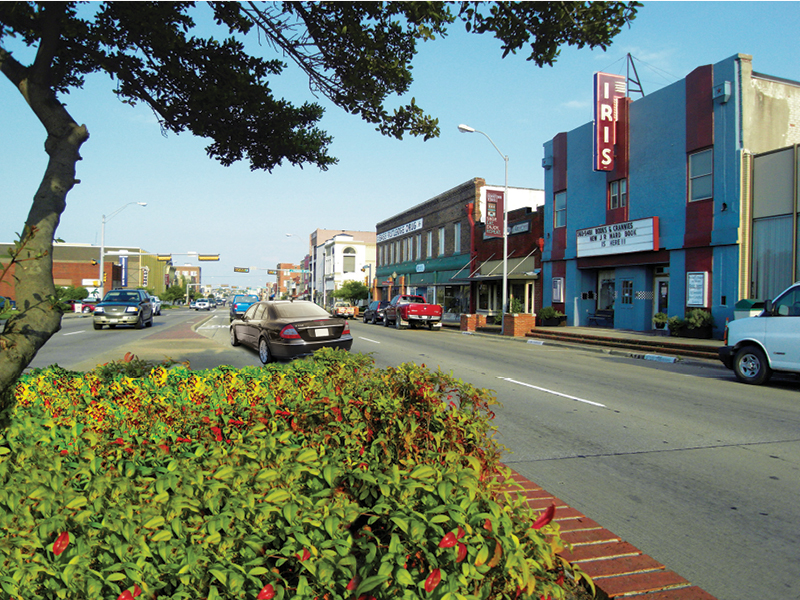
Well-preserved historic buildings and homes of great architectural interest intertwine with business as usual in downtown Terrell. One of the most visited is the 1925 Iris Theatre, where guests find the next best seller or out-of-print books, browse through a consignment boutique, and watch old movies from the building’s original seats. Another gem is the First National Bank building, constructed in 1906 in exemplary Neo-Classical Revival style. A collection of colorful murals covering historic events of the area dot the town, including a series of Hollywood movie posters on the side of the Iris Theatre.
Visitors find an endless array of impressive historic businesses and homes with distinctive architectural features, opulent interior designs, and exquisite landscaping. A self-guided tour helps people navigate to each location. Some structures include: the Saint John Catholic Church, built in 1876 with beautiful stained-glass windows; the Texas & Pacific Railroad Freight Depot, built the same year Terrell was founded in 1873; a one-of-a-kind octagonal home, built in 1861 belonging to the city’s namesake Robert A. Terrell; and the Texas and national historic landmark L.E. Griffith House, built in 1880.
The Terrell Heritage Museum is in a Carnegie Library building built in 1904 and features artifacts from the town’s rich history. The museum also maintains archives and an extensive photograph collection available to researchers.
Beyond history, downtown Terrell offers many attractions and activities. Named for actor Jamie Foxx, who grew up there, is a state-of-the-art performance center presenting world-class entertainment. Other things to do in Terrell include bowling, arcades, movies, country music dancing, beautiful parks, and museums. Plenty of unique shops are downtown and at the nearby outlet mall. Coffee shops, bakeries, and a wide variety of dining choices are available to satisfy even the pickiest eaters. Annual events in Terrell include a four-day old-fashioned jubilee, dinners, and holiday fun.
Film Alley in Terrell offers two bowling alleys, two bars, and eight dine-in theaters.
The famous Ham Orchards store is to the east of Terrell and open seasonally, selling delicious peaches and other produce, jams, fudge, fresh baked goods, and homemade ice cream. It is a favorite destination for many from May through August.
The tiny community of Poetry, Texas, is a fun location for selfies with signs, or just to claim, “I read poetry in Poetry, Texas.”
The Scuba Ranch is located northeast of Terrell. A recreational scuba diving facility, it has a 22-acre spring-fed lake with underwater attractions and wildlife like Sisco the Shark, a fifty-foot metal shark hovering about twenty feet down in the lake.
Also in the Terrell suburbs is Thrillvania Haunted House Park, with three attractions open seasonally, including Verdun Manor, Cassandra’s House of Clowns, and Sam Hain’s Trail of Torment.
For boot scootin’ at its finest, the Silver Saloon offers live country music and dancing throughout the year, often with national touring country music stars.
Nearby Forney is the Antique Capital of Texas with many shops to visit and an active arts council. Other attractions there include the Spellman Museum, Gentle Zoo, Five Points Distilling, and Aim High Indoor Bounce. Historic downtown Forney features several boutique shops and places to dine.
ROCKWALL COUNTY
Rockwall, the town and the county, gets the name from the rock wall structure that lies five to 10 feet underground, not far west of the courthouse square. Scientists determined it is a natural formation. Folktales say prehistoric natives built it.
The arrival of Lake Ray Hubbard in 1967 changed the progressive path of Rockwall County. Built across the entire west side of the county, the close to 23,000-acre lake shares the waters with metropolitan Dallas.
Residents and visitors from all over the world enjoy fishing, boating, and sailing on Lake Ray Hubbard, often with a backdrop of stunning sunrises and sunsets.
An inviting combination of small-town charm and lakeside fun, Rockwall boasts a quaint but thriving historic downtown and a hopping waterfront district along the shores of Lake Ray Hubbard.
The city of Rockwall has noticeable upscale amenities. Dense housing and commercial development along the lake is a contrast to the more spacious countryside experienced as travelers move east into other parts of the county. It is a perfect middle-ground combination of town and country and a favorite change of pace for travelers looking for a bit more polish than the rustic rural towns nearby, without having to go into the congested metroplex.
The Harbor is a lively scene next to the lake, with an elegant Hilton hotel, landscaped walkways, a movie theater, ample shopping and dining opportunities, several water fountains, and a lighthouse. The Harbor hosts a summer Concert by the Lake series each year, providing free live music enjoyed by people on the grassy hills and in boats on the lake.
The city of Rockwall holds the title of Free Live Music Capital of North Texas. Community venues host more than 100 free concerts each year. Besides the concerts by the lake, the San Jacinto Plaza Music Series takes place in historic downtown Rockwall with live music every weekend six months of the year. The town has its own philharmonic orchestra and a long list of local musicians, and puts on a number of summer musicals. A community playhouse offers a full season of theater at an intimate 84-seat facility. An arts league presents exhibits throughout the year and an annual fine art show.
The downtown square is home to old town shops, a historic courthouse, several popular dining experiences, and ongoing and special events that maintain a festive atmosphere. Annual events include coordinated shopping expeditions, cultural and holiday festivals, and an unusual rubber duck race. A seasonal farmers’ market features local produce and specialty foods around the downtown square along with live music. It is easy to find a variety of tasty cuisine in and around Rockwall, including home-style food, wood-fired pizza, street tacos, fresh seafood, upscale burgers, juicy steaks, local wines, and craft brews.
Rockwall offers other entertainment, including ax throwing, bowling, go-karts, fishing, and disc golf. More than 20 developed parks offer playgrounds, ponds, splash pads, and a dog park.
The town has more than 20 miles of walking and biking trails in parks, along streets, in neighborhoods, and an unpaved mountain bike trail. It boasts eight butterfly gardens and pollinator meadows maintained by a volunteer “Butterfly Brigade.” Seven of the sites are Monarch waystations, featuring native plants, unique student-created art, and bee hotels to support local pollinators.
East of Rockwall is Royse City. Rooted in historic preservation, its downtown is the foundation of the community’s unique heritage. Settlers built many of the town’s first structures near the railroad. Today, it conveys a modern vintage atmosphere brimming with restaurants, boutiques, a local meat market in an old-time grocery store, a coffee shop, and an open-air concept beer garden. Cafes serve up award-winning Texas barbecue, gourmet sliders, ice cream, and all the comforts visitors expect to find in an active small town, and offer both indoor “feels like home” ambiance and friendly outdoor patio seating.
Shoppers enjoy discovering an old-fashioned barbershop and shave parlor, delicious baked goods, and an array of products nestled into carefully maintained historic buildings.
Royse City has more than 40 acres of developed park land with four playgrounds, three catch-and-release fishing ponds, and one and a half miles of nature trails.
A vintage caboose full of history and mystery is in the downtown Royse City Old Jail Park. A splash park is a favorite place to cool down on warm days.
Other communities in Rockwall County include Fate, McLendon-Chisholm, and Heath. Attractions include Southern Junction Nightclub and Steakhouse, Stone River Golf Club, Heath Golf & Yacht Club, Urban Air Trampoline Park, Jungle Trek, Sail With Scott and Harbor Lights cruises, San Martino Winery, Buffalo Creek Athletic Club, Rosini Vineyards, and Rockwall County Historical Museum.
Excerpts of this article come from the book, Upper East Side of Texas: Small Towns and Cultural Districts. The book contains more than 300 photographs and commentary on the history, scenery, art, and agriculture of the region. Go to www.SpeckledCrow.com to find it in shops or on Amazon.

