
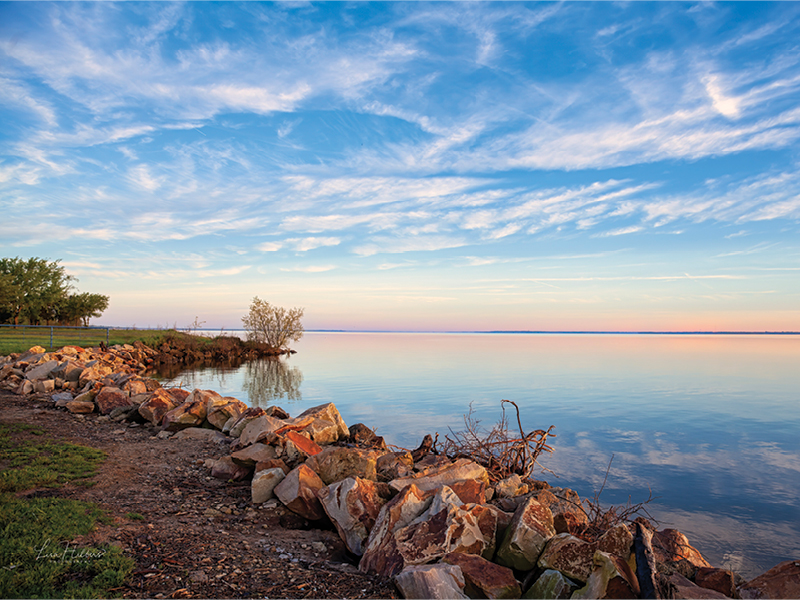
Take an Eagle Eye View of the Lakes and Small Towns of Rains and Wood Counties
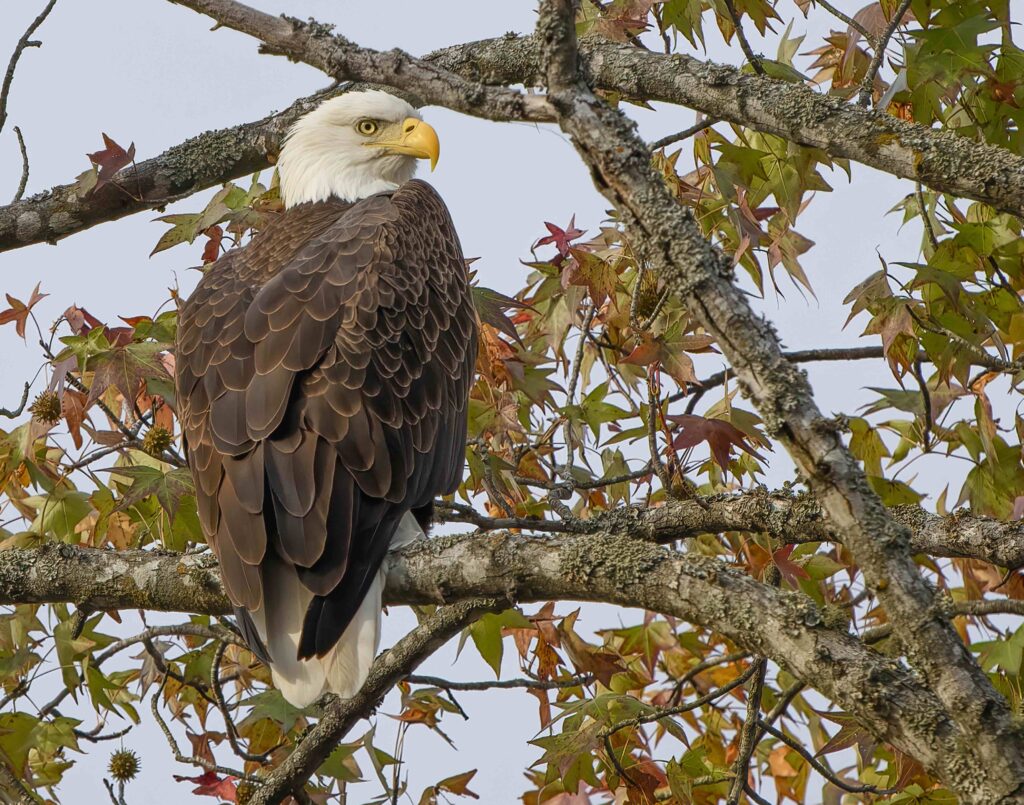
Bald eagle, Lake Holbrook. Photo by Lisa Hilbers
By P.A. Geddie
Eagles soar throughout the Upper East Side of Texas, but the sightings are more common near and around two large, popular bodies of water — Lake Tawakoni and Lake Fork. The lakes are nesting and feeding grounds for bald eagles and more than 260 other bird species. The feathered friends trickle over into several small lakes and natural habitats in the surrounding area.
The Catfish Capital of Texas, Lake Tawakoni is a beautiful body of water covering a massive 37,000 surface acres. With a 200-mile shoreline stretching through Hunt, Rains, and Van Zandt counties, Lake Tawakoni provides water-oriented recreation for much of northeast Texas, while focusing on the preservation of the natural resources present.
Fishing on Lake Tawakoni is popular, and visitors find an abundance of catfish, largemouth bass, crappie, and white, striped, and hybrid bass. Named for a Southern Plains Native American tribe, Lake Tawakoni features hosts of marinas, camps and parks along wooded shores with boat ramps, a weather reporting station, and designated water ski areas. Fishing guides, bait, and tackle are available.
Lake Tawakoni State Park is a good place to kayak or canoe, fish, swim, hike, mountain bike, or go birding or geocaching.
Several resorts, lodges, and rural attractions surround the lake. One is Peninsula Ranch & Lodge overlooking the lake near Quinlan. The Lodge offers 7,000 square feet of living space with covered porches for every room. Native white-tailed and axis deer often feed near the lodge. Donkeys and zebras are commonly nearby, while pelicans and other bird species enjoy the beautiful skies and waters.
Lake Fork covers almost 28,000 acres in Wood, Rains, and Hopkins counties. Holding many of the state records for largemouth bass catches, it is a premier world-class bass fishery.
Lake management hosts multiple tournaments throughout the year, drawing hundreds of fishers to the area. Newcomers to the lake often hire guides, both to help navigate the lake and to find the best places to hunt down the big ones.
Fishers are not the only people to enjoy the lake — birders have a wealth of things to do as well. Besides eagles and hawks making the area home, visitors see bluebirds, bluejays, cardinals, assorted ducks, and white egrets. Two or three times a year, the lake also sees a flock of white pelicans drop in.
Surrounding the lake are several marinas, some of them with attached restaurants serving hamburgers and fresh catfish.
W.C. Swearingen Recreation Area is on the west bank of Lake Fork with pavilions, a playground, barbecue pits, picnic tables, and a wheelchair-accessible floating fishing pier. A Lake Fork recreation facility near Caney Creek includes a pavilion, boat ramp, public parking, and restroom facilities and is home to special events throughout the year.
A couple of good golf courses around the lake include Lake Fork Country Club and The Links at Land’s End.
A few tiny towns worth noting around Lake Fork include Yantis, Alba, and Golden. Golden is the hometown of the multiple Grammy winner and country-music singer Kacey Musgraves. Downtown Golden is a two-country road intersection with nothing more than a quaint little store and an event venue with an arts gallery in a 1912 historic building. The community’s annual Sweet Potato Festival — once featured on the Oprah Winfrey Show — takes place every October.
Between Lake Tawakoni and Lake Fork is Rains County, the Eagle Capital of Texas. The annual Midwinter Bald Eagle Survey takes place in early January with the public invited to join in for eagle viewing on both lakes.
Some of the local fishing guides do eagle sighting excursions, like Curtis Keller with Crappie Curtis Guide Service, who has a 24-foot pontoon boat he takes out for scenic trips tailored for each group’s needs.
Emory
Visitors to the Rains County seat of Emory find a quiet downtown square with a stately courthouse as its centerpiece. Inside are several staircases and a small stage. The courthouse exhibits a unique cruciform plan with projecting wings. The exterior is ginger brick and is designed in the Classical Revival style. It features pilasters and pediment-capped entries, as well as a central dome.
A stroll around the square leads to the discovery of hidden treasures behind rustic, nostalgic facades.
Just down the street is one of East Texas’ outstanding hardware stores. Hooten’s Hardware is “more than just nuts and bolts.” Their fully stocked 40,000-square-foot store has everything one would need to build or tear down anything, as well as an expansive lawn and garden and outdoor living center, appliances, and a general store with home decor and local products.
Emory Heritage Park is located off U.S. Highway 69, next to the Rains County Public Library. Dedicated to the preservation of rural cultural and architectural history in the area, the park is home to many interesting structures from the early 1900s era.
Quitman
On the east side of Lake Fork is Quitman, the county seat of Wood County. Quitman has a charming town square with several popular eateries and a live music bar.
At center stage in Quitman is the Wood County Courthouse, designed and built in 1925 in Classical Revival style. Features include a grand stair with raised entry, a four-column temple front, and a full entablature with dentil molding and pediment.
Quitman’s most famous daughter is actress Sissy Spacek, born and raised there before venturing off to New York to claim her fame. She writes about her childhood fondly in her memoirs.
North of town is Lake Quitman, covering more than 800 acres and popular for fishing and boating.
Close to downtown Quitman are the Governor Jim Hogg City Park and the Wood County Arboretum & Botanical Gardens. The city park includes the Stinson Home, built in 1869, and the Honeymoon Cottage — the ancestral home of the governor featuring original furnishings — and the Ima Hogg Museum. No one is sure what Governor Hogg and his wife, Sarah Ann Stinson, were thinking when they named their baby girl — born July 10, 1882 — Ima Hogg. Despite her unfortunate name, which is part of Texas folklore, she became one of the world’s greatest philanthropists and patrons of the arts.
The arboretum sits next to the city park, covering 23 acres and includes a walking trail, gazebo, several gardens, and flower beds.
Down the street is a premier quilt shop, Stitchin’ Heaven. The 17,500-square-foot facility is the largest quilt shop in the state, providing space for quilters to come together to shop and take classes. Next door is a retreat center offering multi-day quilting retreats throughout the year.
Between Quitman and Mineola is the Wood County Airport Collins Field, several lodging facilities, a yoga retreat center, and a popular dairy farm offering fresh milk, butter, cheeses, and yogurt.
Mineola
With the arrival of the iron horse, Mineola began in the 1870s and remains a railroad and transportation hub today. Carefully maintained historic buildings provide a nostalgic backdrop. Union Pacific and Amtrak trains continue to rumble through town.
Mineola is listed in the National Register of Historic Places. Period lamps line the brick streets, while iron benches, historical markers, a large gazebo, and beautiful outdoor murals invite visitors to come and stay a while.
For a small town, Mineola is bursting at the seams with fun things to do. It is a lovely shopping destination, offering many stores within a few blocks with a variety of products, including clothing, furniture, art, home decor, garden items, and a wide assortment of antiques.
Long-standing popular restaurants serve award-winning barbecue, burgers, country-style favorites, and gourmet food. The Mineola League of the Arts keeps creativity flowing with art shows, while live music is heard regularly in venues and along the downtown streets. Annual events include the Iron Horse Festival, holiday celebrations, and a farmers’ market offers fresh produce, jellies, jams, and homemade remedies.
For overnight lodging, the town has a variety of convenient bed and breakfasts, RV parks, resorts, and hotels. For a unique stay in a small downtown, the renovated Beckham Hotel across from the train station in Mineola comes highly recommended. Originally built in 1892, it has a colorful, and even haunted, history. The Ironhorse Bar & Spirits is in the Beckham as well as a cigar bar, and a ballroom for special events.
Across the street from the Beckham Hotel is the railway station, where passenger trains still stop twice a day. The historic train depot doubles as one of two local history museums and features a small-scale version of a train that people can operate with the push of a button and a mini-train ride for all ages. The Mineola Historical Museum gives guests a sense of the town’s history and the ghosts of a thriving post office that operated there more than 60 years ago.
The Select Theater downtown doubles as a movie theater and a stage for the community theatrical troupe. Guests see new movie releases and enjoy a series of stage performances. Four times a year, the Lake Country Symphonic Band puts on a show. Established in 1920, the Select Theater is one of the oldest movie theaters still operating in Texas.
Just south of town is the award-winning 3,000-acre Mineola Nature Preserve with a backdrop of expansive blue skies and multicolored trees. Visitors enjoy hiking, biking, horseback riding, astronomy, and the Bigfoot Sabine paddling trail.
Outdoor enthusiasts enjoy nearby Lake Holbrook with a beach, picnic areas, and boat ramps.
The Mineola Country Club has a nine-hole golf course, and there is a public-use airport.
Nearby Holly Lake Resort is a popular getaway with built-in fun for families, with hiking trails, swimming pool, canoeing, disc golf, and sports courts.
Southeast of Mineola is the city of Hawkins and Lake Hawkins. Hawkins is the Pancake Capital of Texas. The lake is a popular spot for swimming. It has a sandy beach and fishing and picnic areas. Nearby is Allaso Ranch, a camp and retreat center, with comfortable lodging, a state-of-the-art auditorium and dining hall, and recreation for all ages. Activities include a scenic water park, roaring zip lines, mountain bike and jogging trails, paintball, a challenging high ropes course, horseback riding, and a variety of sporting events.
Winnsboro
Northeast of Lake Fork is Winnsboro, with a thriving downtown environment that includes the Bowery Pedestrian Park, Winnsboro Center for the Arts, and numerous restaurants, boutiques, thrift shops, and art galleries. A long-standing day spa invites weary travelers in for a bit of pampering and relaxation.
Winnsboro’s focus on the arts and history garners it a seat at the table with much larger towns as an official Texas Cultural District. With a very active art center anchoring the community, guests find creativity at every turn.
Live music, community theater performances, poetry readings, artist demonstrations, and art exhibits take place regularly. Throughout the year, special events fill the downtown streets. Major annual gatherings include a book fair, classic car shows, parades, an art and wine festival, and a month-long celebration of autumn.
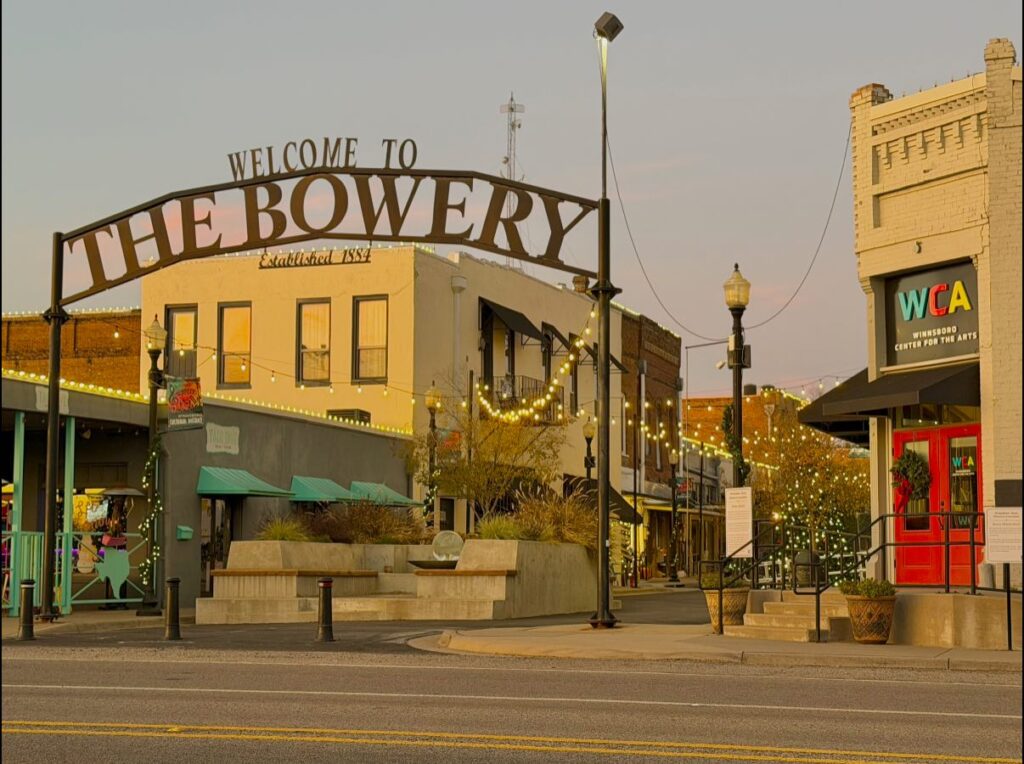
Winnsboro, Texas. Photo by Alex Faber Smith
Creativity also thrives in the good culinary experiences in Winnsboro. Restaurants offer a variety of gourmet, traditional, and multicultural dishes. Local chefs take advantage of their easy connection to neighboring farmers, and even the upscale neighborhood corner store in a renovated gas station offers local and organic food. The town features a thriving year-round farmers’ market.
Outdoor enthusiasts find plenty of opportunities for birdwatching, fishing, swimming, and boating at several lakes just minutes from Winnsboro. Others enjoy soaking up the serenity of a leisurely drive along beautiful meandering country roads, often finding breathtaking views of wildflowers and colorful tree leaves during seasonal changes.
Built in 1908, the Winnsboro Depot Center at the corner of Main and Broadway Street reminds guests of the town’s rich railroad history. Fully restored, it houses offices and meeting rooms for area organizations and the Winnsboro Historical Museum. As the railroad made its way to Winnsboro in the late 1800s, it became a shipping center for timber and agricultural commodities. Loggers looking for entertainment led to the opening of saloons and gambling halls along the alley street north of the depot. They called it “The Bowery.” Stories of that era are still recounted today and sometimes depicted in historical re-enactments, as are later visits from the notorious crime duo Bonnie Parker and Clyde Barrow.
The Bowery became Market Street as saloons and gambling halls became grocery and feed stores and later the boutiques, eateries, and art shops of today. Dedicated community members continue to renovate, restore, and create positive improvements that make their town welcoming to residents and visitors alike.
This article comes from the book, Upper East Side of Texas: Small Towns and Cultural Districts. The book contains more than 300 photographs and commentary on the history, scenery, art, and agriculture of the region. Go to www.SpeckledCrow.com to find it in shops or on Amazon.

